


 VI
Accounting Firm in Hanoi for a Foreign-Owned Company: 7 Questions to Ask Before You Sign
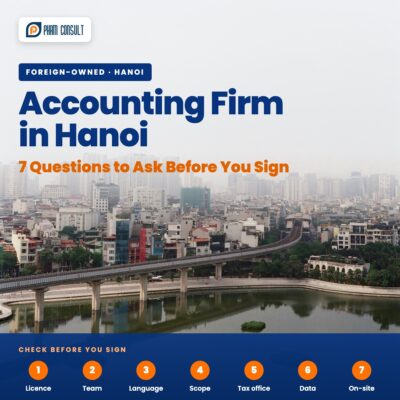
An accounting firm in Hanoi that serves a foreign-owned company should be able to show three things before you sign: that it is legally allowed to provide accounting services, who will actually do the work and report to you in English, and exactly which monthly, quarterly and annual tasks are inside the fee. The seven questions below help you test all three in a single meeting.
This guide is written for foreign owners, regional finance teams and newly appointed directors setting up or running a company in Hanoi. It reflects Vietnam’s Law on Accounting No. 88/2015/QH13 as in force on 1 November 2026 and adds practical points from working with foreign-owned clients. Where a point is professional judgment rather than law, we say so.
Why choosing an accounting firm in Hanoi needs a structured check
Vietnamese books must be kept in Vietnamese, in Vietnamese dong unless specific conditions are met, and under Vietnamese accounting rules. Your parent company, meanwhile, probably expects English reports, group formats and fast answers. An accounting firm in Hanoi sits between those two worlds, so a weak choice shows up quickly: late returns, reports nobody at head office can read, and questions from the tax office that the provider cannot explain.
The Law on Accounting also places responsibility on the company itself. Hiring an accounting firm in Hanoi does not move the legal duty to keep proper books away from the company and its legal representative. The firm performs the work; the company remains accountable for it. That is why the selection deserves more than a price comparison.
Question 1: Is the firm licensed to provide accounting services?
Under Article 59 of the Law on Accounting, an enterprise may provide accounting services only when it meets the statutory conditions and holds a Certificate of eligibility for accounting service business. Article 60 sets those conditions; for a multi-member limited liability company they include at least two capital-contributing members who are practising accountants, and a legal representative, director or general director who is a practising accountant.
Ask the accounting firm in Hanoi for a copy of its certificate and check that the company name and address match its business registration. Ask also which of its accountants hold a Certificate of registration for accounting service practice under Article 58. A firm that hesitates to share these documents is a red flag.
Question 2: Who will do the work, and who is your contact?
Many foreign owners meet a senior partner during the pitch and then deal with a junior accountant they have never met. Ask the accounting firm in Hanoi to name the engagement manager, the day-to-day accountant and the backup when either is away. Ask how many clients each person handles and what happens during peak periods such as the annual finalisation season.
Agree a single point of contact who answers in English, and set expected response times in writing. In our experience, a clear contact and backup matter more to a foreign owner’s satisfaction than any other service feature.
It also helps to ask how knowledge is recorded. A provider that keeps a written client file, covering the chart of accounts, recurring entries, tax positions and open questions, can replace a staff member without disruption. A provider that relies on one person’s memory cannot. Ask to see the template the firm uses for that file, even if the content is blank.
Question 3: In which language and format will you receive reports?
Article 11 of the Law on Accounting requires Vietnamese as the accounting language. Where a foreign language is used on accounting documents, books or financial statements in Vietnam, Vietnamese and the foreign language must be used together. Article 10 sets Vietnamese dong as the accounting currency, while an entity that mainly receives and pays in one foreign currency may choose that currency, subject to notifying the managing tax office and converting to dong for financial statements used in Vietnam.
In practice, ask the accounting firm in Hanoi to show a sample monthly management pack in English: profit and loss, balance sheet, cash position, VAT and corporate income tax summary, and a short commentary. If your parent company needs group formats, ask how the firm maps Vietnamese accounts to the group chart and who prepares that mapping.
Timing matters as much as language. Agree the working day on which the books close and the date by which the pack reaches you. Many groups need Vietnamese figures within the first week of the following month for consolidation; that is only realistic if your own team sends bank statements, invoices and approvals on time. Write both sides of that timetable into the engagement letter.
Question 4: What is inside the scope, and what is extra?
Article 56 requires an outsourced accounting or chief accountant service to be set out in a written contract. A good engagement letter from an accounting firm in Hanoi lists each task, its frequency and the deadline by which you must deliver documents. The table below is a practical checklist; it is a professional view, not a list required by law.
| Area | What the engagement letter should state | Why it matters |
|---|---|---|
| Bookkeeping | Monthly recording, bank and ledger reconciliations, fixed asset register | Defines what is closed each month |
| Tax returns | VAT, corporate income tax provisional payments, personal income tax withholding, annual finalisation | Avoids gaps between bookkeeping and tax |
| Payroll | Whether payroll, social insurance and payslips are included | Often assumed but not included |
| Reporting | Format, language and date of the monthly pack | Sets what head office receives |
| Statutory reports | Annual financial statements and their submission | Year-end workload is the largest |
| Tax office contact | Who answers tax office questions and attends meetings | Tests real responsibility |
| Chief accountant | Whether the firm provides a chief accountant under Article 56 | Needs a qualified person under Article 54 |
| Exclusions | Audits, tax inspections, transfer pricing, special projects | Prevents surprises later |
When you compare proposals, put them side by side against this same list. Two quotes that look different in price often cover different work: one includes payroll and the annual financial statements, the other does not. Asking every provider to price the same written scope is the simplest way to compare like with like.
Question 5: How does the accounting firm in Hanoi handle the tax office?
A company in Hanoi files returns electronically, but questions, clarification requests and inspections still need someone who can explain the figures. Ask the accounting firm in Hanoi whether it prepares responses to tax office letters, attends meetings with the company, and how it charges for that time. Ask also whether it can act as a tax agent for submitting returns, or whether filing remains with the company.
Because the tax administration was reorganised in 2025, check which tax office manages your company before relying on any provider’s description of local practice. The national filing rules do not change by city; for an example, see our guide to VAT filing for a new company.
Question 6: How are your data and documents protected?
Your provider will hold salary data, bank details and contracts. Ask the accounting firm in Hanoi where records are stored, who can access them, how access ends when staff leave, and how documents are returned at the end of the engagement. Article 41 of the Law on Accounting requires accounting records to be stored safely and kept for minimum periods, starting with at least five years for records used for management, so the handover process matters if you change provider.
Article 68 also lists situations in which a firm must not provide accounting services, including where the people performing the service have family relationships with the client’s managers or chief accountant, or economic and financial relationships with the client. Ask the firm to confirm in writing that none of these situations applies.
Ask about systems as well. Which accounting software is used, who owns the licence and the data file, and can you export the full ledger at any time? Can head office have read-only access? How are invoices received from suppliers, and how are payment approvals documented? Clear answers here make audits, due diligence and a future change of provider much easier.
Question 7: Do you need someone on site in Hanoi?
Most bookkeeping can be done remotely with e-invoices, bank feeds and shared folders. Some tasks still benefit from a person who can visit: collecting original documents, attending a tax meeting, or supporting a year-end stock count. Ask the accounting firm in Hanoi which of these it covers and how quickly someone can be at your office.
A provider with a physical office in Hanoi is not required by law, but for many foreign-owned companies it reduces delays. This is a professional view; companies with fully digital processes may be well served by a provider based elsewhere in Vietnam.
A hypothetical example: comparing two proposals
The following example is hypothetical. A Singapore-owned trading company opens in Hanoi with twelve employees and receives two proposals. Provider A quotes a lower monthly fee, but its scope covers bookkeeping and VAT returns only, with payroll, the annual financial statements and tax office meetings charged separately. Provider B quotes more, but includes payroll, a monthly English management pack, the annual financial statements and up to two tax office meetings a year.
Once the company adds the items it actually needs, the gap between the two proposals narrows sharply. The company also notices that Provider A cannot name the person who would prepare its reports. The lesson is not that the higher quote is always better, but that only a written, comparable scope shows what each fee really buys.
Red flags when comparing an accounting firm in Hanoi
- No certificate of eligibility for accounting service business, or reluctance to show it.
- A price without a written scope, or a scope that says only “accounting services”.
- No named contact who can explain reports in English.
- Promises such as “guaranteed no tax risk” or “we can always reduce your tax”.
- No clear process for responding to the tax office.
- No plan for returning records at the end of the engagement.
The first 30 days with a new accounting firm in Hanoi
A simple onboarding plan keeps the first month on track and shows quickly whether the working relationship will hold.
| Week | Task | Owner |
|---|---|---|
| 1 | Sign the engagement letter; share ERC, IRC, tax code, bank and e-invoice access | Company |
| 1–2 | Receive the opening balance review and a list of missing documents | Accounting firm |
| 2 | Agree the monthly calendar: document cut-off, close date, report date | Both |
| 3 | Confirm VAT method and filing period, and the first tax deadlines | Accounting firm |
| 4 | Receive the first monthly pack and review it in a short call | Both |
Running this short onboarding plan with any accounting firm in Hanoi exposes gaps early, while they are still cheap to fix.
FAQ: hiring an accounting firm in Hanoi
Can a foreign-owned company outsource its chief accountant role? Yes. Article 56 allows an accounting entity to hire an accounting service enterprise to provide accounting or chief accountant services under a written contract, and the person hired as chief accountant must meet the standards in Article 54.
Can the books be kept in English only? No. Article 11 requires Vietnamese; a foreign language may be used together with Vietnamese on documents, books and financial statements.
Does an accounting firm in Hanoi need a licence? Yes. Articles 59 and 60 require a Certificate of eligibility for accounting service business.
What fee should we expect? Fees depend on transaction volume, scope and reporting needs. Ask each provider to quote against the same written scope so that the comparison is fair.
How long does it take to change provider? Plan for at least one full month of overlap: the outgoing provider closes the last period and hands over records, and the new one reviews opening balances before taking over the next close.
Should the provider also handle payroll? It often makes sense, because salary costs, personal income tax and social insurance flow straight into the books and tax returns. If payroll stays in-house, agree how and when payroll data reaches the accountant each month.
How Pham Consult supports companies looking for an accounting firm in Hanoi
Pham Consult provides accounting services and outsourced bookkeeping for foreign-owned companies, with offices in Hanoi and Ho Chi Minh City. Our team reports in English and Vietnamese, prepares monthly management packs and supports clients with tax returns and tax office questions. You can read more about how we work as an accounting firm for foreign-owned companies.
If you are comparing providers, request a sample monthly report or book a scope call with Pham Consult, or call +84 909 660 105. We will walk through the seven questions above with you and show how we would answer each one as your accounting firm in Hanoi.
This article reflects the Law on Accounting as in force on 1 November 2026 and is general information, not legal advice for a specific case.
