



 VI
VAT Filing for a New Company in Vietnam: Monthly or Quarterly, and Which VAT Method?
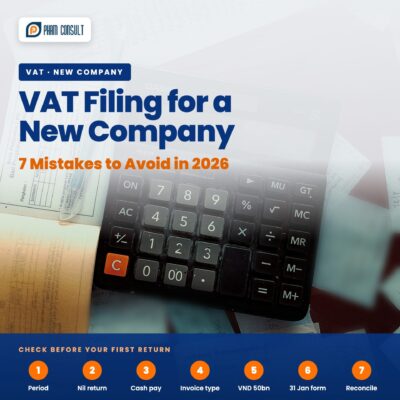
VAT filing for a new company in Vietnam comes down to two early decisions: which VAT method the company uses (deduction or direct) and whether it files VAT returns monthly or quarterly. Under Circular 89/2026/TT-BTC, effective 1 July 2026, a newly operating taxpayer may choose quarterly VAT filing, then reassesses its filing period against the VND 50 billion revenue test once it has a full year of trading.
This guide is written for founders, finance managers and foreign owners who have just received an Enterprise Registration Certificate (ERC). It explains the rules in force on 1 November 2026, shows how each choice affects your first tax year, and lists the mistakes we see most often in VAT filing for a new company.
Quick answer: VAT filing for a new company in 2026
- Default: VAT is declared monthly (point a, clause 1, Article 19 of Circular 89/2026/TT-BTC).
- A taxpayer that has just started operating may choose quarterly VAT filing (point b.1.2).
- If revenue in the first calendar year exceeds VND 50 billion, the company files monthly from the next calendar year (point b.1.2).
- Most companies registered as enterprises use the deduction method once annual revenue reaches VND 1 billion, or earlier if they opt in voluntarily (clause 2, Article 11 of the VAT Law 48/2024/QH15).
- Monthly returns are due by the 20th of the following month; quarterly returns by the last day of the first month of the next quarter (Decree 252/2026/ND-CP).
The two VAT methods available to a new company
Vietnam’s VAT Law No. 48/2024/QH15, in force since 1 July 2025, keeps two methods. Under the deduction method, VAT payable equals output VAT minus creditable input VAT (clause 1, Article 11). Under the direct method on revenue, VAT payable is a fixed percentage of revenue, and input VAT cannot be credited (clause 2, Article 12).
The comparison below shows why the choice matters for VAT filing for a new company, especially one that spends heavily on fit-out, equipment or imported goods in its first months.
| Aspect | Deduction method | Direct method on revenue |
|---|---|---|
| Legal basis | Article 11, VAT Law 48/2024/QH15 | Clause 2, Article 12, VAT Law 48/2024/QH15 |
| Who uses it | Businesses with annual revenue of VND 1 billion or more that keep full accounting records, invoices and documents; businesses that opt in voluntarily | Enterprises and cooperatives below the VND 1 billion revenue threshold, unless they opt for the deduction method |
| How VAT is calculated | Output VAT minus creditable input VAT | Revenue × fixed rate: 1% distribution of goods, 5% services, 3% production and transport, 2% other activities |
| Input VAT | Creditable if the conditions in Article 14 are met | Not creditable |
| Invoices issued | VAT invoices | Sales invoices |
| Typical fit | Foreign-owned companies with B2B customers, start-up costs or imports | Very small businesses with low costs and few business customers |
For most foreign-owned companies, the deduction method is the practical default. Business customers usually expect a VAT invoice they can credit, and the start-up phase often produces input VAT on rent, equipment and services that the company will want to recover. This is a professional view, not a legal requirement; a company with very low revenue and few costs may reasonably stay on the direct method.
How to choose the VAT method as part of VAT filing for a new company
Clause 2, Article 11 of the VAT Law lets a business apply the deduction method voluntarily, even before it reaches VND 1 billion in annual revenue, provided it keeps full accounting records, invoices and documents. The registration step is handled with the managing tax office under the Government’s guiding rules on VAT, so confirm the procedure and timing with your tax office or adviser before issuing the first invoice.
Three questions usually settle the choice of method for VAT filing for a new company:
- Will most customers be VAT-registered businesses that need a VAT invoice to claim input VAT?
- Will the company incur significant input VAT before it earns revenue (office fit-out, machinery, imported inventory)?
- Can the company keep full accounting records from day one, either in-house or through an outsourced accounting service?
If the answer to all three is yes, the deduction method is normally the better fit. Remember that input VAT is creditable only with a VAT invoice and a non-cash payment document for the purchase, except in special cases set by the Government (points a and b, clause 1, Article 14 of the VAT Law). Paying suppliers in cash is one of the easiest ways to lose input VAT in the first year.
Monthly or quarterly: the 2026 rule for VAT filing for a new company
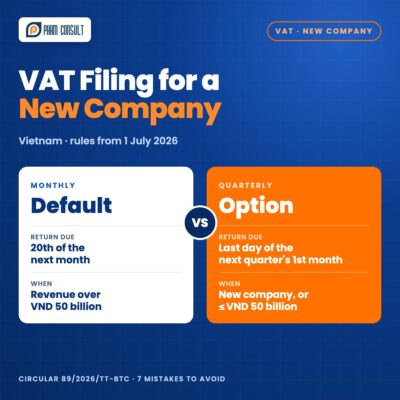
From 1 July 2026, the filing-period rules sit in Article 19 of Circular 89/2026/TT-BTC, which guides the Tax Administration Law No. 108/2025/QH15 and Decree 252/2026/ND-CP. Monthly filing is the default (point a, clause 1). Quarterly filing is available in two situations (point b.1):
- A taxpayer whose total revenue from goods and services in the preceding year was VND 50 billion or less may choose quarterly filing (point b.1.1).
- A taxpayer that has just started operating may choose quarterly filing (point b.1.2).
Point b.1.2 then sets out how the period is reviewed. If revenue in the first year of trading is VND 50 billion or less, the company waits until it has traded for a full 12 months. From the calendar year after the year in which those 12 months are completed, it uses the revenue of the preceding full calendar year to decide between monthly and quarterly filing. If revenue in the first calendar year exceeds VND 50 billion, even for less than 12 months of trading, the company must file monthly from the next calendar year.
Point b.1.3 places the responsibility on the taxpayer: the company itself must determine whether it files monthly or quarterly. In other words, VAT filing for a new company does not wait for a notice from the tax office; the company decides, and it carries the consequences if the decision is wrong.
| Situation | Filing period | Basis |
|---|---|---|
| Company has just started operating | May choose quarterly (or stay monthly) | Point b.1.2, clause 1, Article 19, Circular 89/2026/TT-BTC |
| First calendar year revenue over VND 50 billion | Monthly from the next calendar year | Point b.1.2 |
| First-year revenue VND 50 billion or less | Keep the chosen period until 12 full months of trading; then test the preceding full calendar year | Point b.1.2 |
| Established company, prior-year revenue VND 50 billion or less | May choose quarterly | Point b.1.1 |
| Established company, prior-year revenue over VND 50 billion | Monthly | Point a |
| Company that chose a period | Applies it for the whole calendar year | Point b.2.1 |
Filing deadlines for monthly and quarterly VAT returns
Deadlines are where VAT filing for a new company most often goes wrong, because the first return falls due before routines are in place. The deadlines below come from Decree 252/2026/ND-CP, which guides the Tax Administration Law from 1 July 2026. They apply to the return; the tax payment deadline normally follows the return deadline, so plan cash for the same date.
| Return | Deadline | Basis |
|---|---|---|
| Monthly VAT return | No later than the 20th day of the month following the month in which the tax obligation arises | Decree 252/2026/ND-CP (verified via the Government portal) |
| Quarterly VAT return | No later than the last day of the first month of the following quarter | Decree 252/2026/ND-CP (verified via the Government portal) |
| Example: Q4 2026 quarterly return | 31 January 2027 | Calculated from the rule above |
| Example: November 2026 monthly return | 20 December 2026 | Calculated from the rule above |
A practical tip for VAT filing for a new company: build the first twelve deadlines into a shared calendar on the day the ERC is issued. The first deadline is the one most often missed, because nobody owns it yet.
A worked example of VAT filing for a new company (hypothetical)
The following example is hypothetical and is included only to show how the rules interact. A foreign-owned consulting company receives its ERC in August 2026, registers for the deduction method and chooses quarterly VAT filing under point b.1.2.
- Q3 2026 (August–September): the first quarterly return is due by 31 October 2026, even if the company has little or no revenue.
- Q4 2026: due by 31 January 2027.
- Calendar year 2026 revenue is VND 3 billion, well under VND 50 billion, so the company keeps quarterly filing in 2027.
- The company completes 12 months of trading in August 2027. From 2028, it tests calendar year 2027 revenue: VND 50 billion or less means it may stay quarterly.
If the same company had earned more than VND 50 billion in calendar year 2026, it would have to switch to monthly VAT filing from January 2027, regardless of having traded for only five months.
Switching between monthly and quarterly filing
Circular 89/2026/TT-BTC also covers changes after the first choice. A taxpayer that meets the quarterly criteria applies the chosen period for the whole calendar year (point b.2.1). A company filing monthly that becomes eligible and wants to move to quarterly filing must send form 01/ĐK-TĐKTT to its managing tax office no later than 31 January of the year in which quarterly filing starts (point b.2.2).
The reverse case is the costly one. If the company, or the tax office, finds that it was not eligible for quarterly filing, it must file monthly from the first month of the next quarter, refile monthly returns for the earlier quarters and pay late-payment interest. The circular states that no late-filing penalty applies to those refiled returns (point b.2.3), but the interest and the extra workload remain. This is why VAT filing for a new company should include a revenue check every quarter in the first year.
7 mistakes in VAT filing for a new company
The list below reflects common problems seen in practice. It is a professional view based on the rules above, not an exhaustive legal list.
- Assuming the tax office will tell the company its filing period. Under point b.1.3, the taxpayer decides and is responsible for the decision.
- Not filing a return for a quarter with no revenue. A nil return is still a return, and the deadline still applies.
- Paying suppliers in cash and losing input VAT because there is no non-cash payment document (point b, clause 1, Article 14 of the VAT Law).
- Issuing sales invoices under the direct method to business customers that expected VAT invoices, then having to correct the method and the invoices.
- Ignoring the VND 50 billion test in the first calendar year. A fast-growing company can cross it in a few months and must then file monthly from the next year.
- Missing the 31 January deadline for form 01/ĐK-TĐKTT when moving from monthly to quarterly filing.
- Keeping VAT working papers separate from the books. Output and input VAT should reconcile to the general ledger every period; see our guide to bookkeeping for a new company in Vietnam.
Checklist: VAT filing for a new company in the first 90 days
Use the steps below as a working plan for the first three months after the ERC is issued.
| Step | What to do | Owner |
|---|---|---|
| 1 | Confirm the VAT method (deduction or direct) and register it with the managing tax office if needed | Director with tax adviser |
| 2 | Decide monthly or quarterly filing and record the decision and its basis in writing | Finance / tax agent |
| 3 | Set up e-invoicing and digital signatures before the first sale | Finance |
| 4 | Pay suppliers by bank transfer to keep input VAT creditable | Finance |
| 5 | Put the first 12 VAT deadlines in a shared calendar | Finance / tax agent |
| 6 | Reconcile output and input VAT to the books before each return | Accountant |
| 7 | Review cumulative revenue against VND 50 billion every quarter | Finance manager |
FAQ on VAT filing for a new company in Vietnam
Can a newly established company file VAT quarterly from the start? Yes. Point b.1.2, clause 1, Article 19 of Circular 89/2026/TT-BTC allows a taxpayer that has just started operating to choose quarterly VAT filing.
Does the company need to notify the tax office to start quarterly filing? For a newly operating company, the circular frames quarterly filing as the taxpayer’s own choice and responsibility (points b.1.2 and b.1.3). Form 01/ĐK-TĐKTT is required when an existing monthly filer switches to quarterly (point b.2.2). Confirm the practical steps with your managing tax office.
What if there is no revenue in the first quarter? VAT filing for a new company still requires a return for each period once the obligation to declare arises, even if the figures are zero.
Can a new company use the deduction method before reaching VND 1 billion revenue? Yes, if it opts in voluntarily and keeps full accounting records, invoices and documents (point b, clause 2, Article 11 of the VAT Law).
Do these rules apply to companies in Ho Chi Minh City and Hanoi alike? Yes. The filing rules are national; only the managing tax office differs by location.
How Pham Consult supports VAT filing for a new company
Pham Consult works with foreign-owned and Vietnamese companies from offices in Ho Chi Minh City and Hanoi. For VAT filing for a new company, our tax consulting team can review the choice of VAT method and filing period, and our tax agent service can prepare and submit monthly or quarterly returns, reconcile them to the books and track each deadline.
If you have just received your ERC, a short review now can prevent a year of corrections later. Book a tax review with Pham Consult or call +84 909 660 105 to discuss VAT filing for a new company in your situation.
This article reflects regulations in force on 1 November 2026 and is general information, not legal or tax advice for a specific case
