


 VI
Outsourced Accounting vs. In-House Accounting: Which Is Right for Your Business?
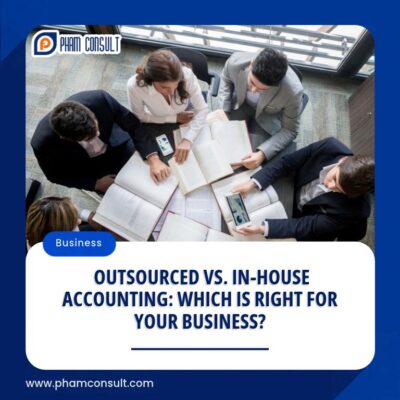
Managing accounting operations is an essential part of running a business. However, many companies face an important decision: Should they outsource their accounting functions to a professional service provider or hire an in-house accounting team?
This decision involves more than comparing monthly service fees with employee salaries. It can directly affect financial control, operational efficiency, the reliability of accounting information, and compliance with applicable regulations.
For newly established companies, maintaining a full-time accounting team may not always be necessary, particularly when transaction volumes are limited. In contrast, businesses with complex operations, multiple locations, or frequent financial reporting requirements may benefit from having dedicated accounting personnel.
So, is outsourced accounting or in-house accounting the better option for businesses operating in Vietnam?
In this article, PHAM CONSULT examines the key differences, advantages, disadvantages, cost considerations, and legal requirements associated with both approaches, helping businesses make informed decisions based on their operational needs.
1. What Are In-House Accounting and Outsourced Accounting?
1.1. What Is In-House Accounting?
In-house accounting refers to an arrangement in which a company directly recruits, employs, and manages accounting personnel to handle its accounting activities.
Depending on the size and nature of the business, an in-house accounting team may be responsible for:
- Examining and recording accounting transactions and supporting documents.
- Monitoring revenue, expenses, accounts payable, accounts receivable, and inventory.
- Maintaining accounting records and preparing financial reports.
- Coordinating activities related to tax compliance.
- Providing financial information to support management and business decisions.
One of the main advantages of in-house accounting is the ability to work directly with other departments. This arrangement can facilitate communication, support day-to-day financial operations, and help accounting personnel develop a deeper understanding of the company’s business activities.
However, establishing an internal accounting department also requires investment in recruitment, training, employee management, and appropriate accounting systems.
1.2. What Is Outsourced Accounting?
Outsourced accounting is an arrangement in which a business engages a qualified external accounting service provider to perform some or all of its accounting functions under a service agreement.
Depending on the agreed scope of services, outsourced accounting may include:
- Examining and processing accounting documents.
- Maintaining accounting books and records.
- Preparing financial statements and management reports.
- Reviewing accounting data and identifying discrepancies.
- Providing advice on accounting systems and procedures.
- Supporting the resolution of technical accounting issues.
Unlike directly employing accounting personnel, outsourcing allows a business to obtain professional accounting support through a contractual relationship.
However, the effectiveness of outsourced accounting services depends on several factors, including the provider’s professional competence, the accuracy of financial documents, the agreed scope of work, and the communication procedures established between the parties.
2. Outsourced Accounting vs. In-House Accounting: Key Differences
When choosing between outsourced accounting and an in-house accounting team, businesses should consider financial costs, operational requirements, data management, and professional expertise.
The following table provides a comparison of the two approaches.
| Criteria | In-House Accounting | Outsourced Accounting |
| Cost structure | Employee salaries, insurance contributions, training, and operating expenses | Contractual service fees and additional charges where applicable |
| Human resources | Personnel are directly recruited and managed by the company | The service provider assigns personnel to perform the agreed tasks |
| Daily operations | Facilitates frequent coordination and immediate handling of routine tasks | Depends on agreed response times and contractual scope |
| Professional expertise | Depends on the qualifications and experience of recruited employees | Depends on the competence of the external accounting team |
| Data control | The company manages internal access and authorization procedures | Requires clear arrangements for data access, confidentiality, and transfer |
| Flexibility | Staffing levels must be adjusted as business requirements change | Service scope may be adjusted through contractual agreements |
| Business continuity | Operations may be affected by employee turnover | Depends on the provider’s staffing continuity and handover arrangements |
Both approaches offer different advantages.
An in-house accounting team can provide greater convenience when accounting information must be processed continuously. Meanwhile, outsourced accounting services may give companies access to professional expertise without requiring them to maintain a complete accounting department.
Nevertheless, outsourcing does not automatically guarantee lower costs, nor does employing an internal accounting team necessarily ensure better financial control.
The effectiveness of either model depends on how accounting responsibilities, internal procedures, and quality assurance mechanisms are organized.
3. Outsourced Accounting Costs vs. In-House Accounting Costs
Cost is often one of the most important considerations when selecting an accounting model.
However, businesses should evaluate the total cost of accounting operations rather than compare an employee’s monthly salary with an accounting service provider’s monthly fee.
3.1. Costs of Hiring an In-House Accounting Team
When maintaining an internal accounting department, businesses generally need to consider several cost categories:
- Employee salaries, bonuses, and allowances.
- Mandatory employer social insurance and other statutory contributions.
- Recruitment and professional training expenses.
- Accounting software, equipment, and workplace expenses.
- Management, supervision, and internal review costs.
- Additional recruitment or replacement costs when employees leave.
Beyond personnel expenses, companies must also consider the selection, implementation, and maintenance of accounting software.
Appropriate accounting software should support accurate transaction recording, data security, and the preparation of information required for financial management.
Businesses seeking further information can refer to PHAM CONSULT’s article on accounting software regulations in Vietnam in 2026.
The article discusses accounting software requirements and responsibilities relating to the accuracy of accounting information.
3.2. Costs of Outsourced Accounting Services
The cost of outsourced accounting services may vary depending on the company’s operations and reporting requirements.
Several factors can influence service fees:
- The number of accounting documents and transactions.
- The nature of the company’s industry and business activities.
- The complexity of accounting treatments.
- The scope of accounting work covered by the agreement.
- The frequency of financial and management reporting.
- Requirements for specialized accounting advice.
- Communication, documentation, and reporting arrangements.
Businesses should pay particular attention to services that are not included in the standard contractual scope.
For example, preparing periodic financial statements, producing customized management reports, and providing specialized support for complex accounting matters may involve different service arrangements.
Therefore, before selecting an outsourced accounting provider, companies should request a clear explanation of the services included, expected deliverables, reporting deadlines, and potential additional fees.
3.3. Cost Considerations for Different Types of Businesses
The following hypothetical examples illustrate how accounting requirements may differ between companies.
Scenario 1: A Newly Established Trading Company
Consider a newly established trading company with a relatively small number of transactions and straightforward accounting records.
Its primary accounting requirements involve bookkeeping and periodic financial reporting.
In this situation, outsourced accounting may be worth considering because maintaining a full-time accounting employee may not be necessary.
However, the business would still need an internal representative to organize and provide supporting documents, review information, and coordinate with the service provider.
Scenario 2: A Manufacturing Company with Complex Operations
Consider a manufacturing company operating multiple warehouses and regularly monitoring raw materials, production expenses, inventory, product costing, and outstanding receivables and payables.
Because financial information must be updated frequently, the company may benefit from maintaining an in-house accounting team that can coordinate directly with production, warehouse, and sales departments.
These scenarios are illustrative only. They are not based on actual client quotations or measured cost savings.
The most affordable accounting arrangement is not necessarily the most effective one. Businesses should evaluate cost efficiency alongside reporting quality, operational requirements, and financial control.
4. When Should a Business Outsource Its Accounting?
Outsourced accounting services may be appropriate when a company has specific operational characteristics or accounting requirements.
4.1. Newly Established Businesses
During their early stages, businesses often prioritize financial resources for business development, customer acquisition, and cash flow management.
Where accounting transactions remain relatively limited, outsourcing can provide a way to organize accounting activities without immediately establishing a fully staffed internal department.
4.2. Businesses with Irregular Transaction Volumes
Some companies experience seasonal operations or significant fluctuations in transaction volumes.
In such circumstances, accounting workloads may vary throughout the year.
Outsourcing can allow these businesses to negotiate a service scope that better reflects their operational needs, subject to the terms of their agreements.
4.3. Businesses Requiring Specialized Accounting Expertise
Not every company has an accounting team with sufficient experience to handle complex transactions or design effective internal accounting procedures.
External professional support may be useful for:
- Reviewing accounting records and financial information.
- Providing technical accounting advice.
- Improving accounting procedures.
- Supporting the development of accounting and internal control systems.
In such cases, businesses may obtain specialized assistance without necessarily recruiting additional permanent personnel.
5. When Should a Business Hire an In-House Accounting Team?
An in-house accounting model may be more appropriate for organizations requiring frequent financial information processing and direct operational coordination.
Businesses should consider this arrangement in the following situations.
High daily transaction volumes
Companies processing numerous transactions may require continuous monitoring of accounting documents, payments, and outstanding balances.
Having dedicated accounting personnel can facilitate regular communication with other departments.
Multiple warehouses, branches, or operating locations
Businesses managing multiple locations may benefit from accounting personnel who work directly with operational teams to monitor inventory, reconcile transactions, and maintain accurate records.
Frequent management reporting requirements
Companies requiring regular reports on costs, revenue, profitability, departmental performance, or cash flow may need accounting information to be updated continuously.
Specific internal control requirements
Organizations with complex approval procedures, sensitive financial information, or detailed internal authorization systems may prefer accounting personnel who operate directly within their management structure.
However, recruiting in-house accountants does not automatically establish an effective accounting system.
The quality of accounting operations still depends on employee competence, internal controls, clearly defined responsibilities, and management oversight.
6. Can Businesses Combine In-House and Outsourced Accounting?
Companies do not necessarily have to choose between a completely internal accounting department and full accounting outsourcing.
A hybrid accounting model, combining in-house accounting personnel with external professional accounting services, may provide a suitable alternative.
Under this approach, internal employees handle routine activities, while an external service provider assists with specialized work defined in the service agreement.
A possible division of responsibilities is illustrated below.
| In-House Accounting Team | External Accounting Service Provider |
| Collect and organize daily accounting documents | Review and reconcile accounting information |
| Monitor cash transactions and outstanding balances | Assist with financial statement preparation |
| Coordinate with internal departments | Provide technical accounting advice |
| Update operational accounting information | Support the improvement of accounting systems |
A hybrid model may be particularly relevant to growing businesses that require regular accounting support but do not yet need a complete internal team covering every specialized function.
Nevertheless, both parties must establish clear responsibilities concerning document submission, data verification, reporting deadlines, and error resolution.
Without appropriate coordination procedures, a hybrid arrangement may result in duplicated work, incomplete information, or uncertainty regarding accountability.
7. Legal Considerations When Outsourcing Accounting Services in Vietnam
Businesses operating in Vietnam must ensure that their accounting arrangements comply with applicable Vietnamese laws and regulations.
Under Article 56 of Vietnam’s Law on Accounting, as consolidated in Document No. 41/VBHN-VPQH dated March 16, 2026, accounting entities may engage eligible accounting service providers to perform accounting services or chief accountant services in accordance with the law.
The engagement of accounting services must be established through a written contract.
The accounting entity receiving the services is responsible for providing complete, timely, and accurate information and relevant documents, as well as paying the agreed service fees.
Accounting service providers and individuals performing the contracted accounting work bear responsibility for accounting information and data in accordance with the contractual arrangements and applicable legal requirements.
The consolidated legislation can be accessed through the Official Gazette of the Government of Vietnam – Consolidated Law on Accounting.
Before entering into an accounting outsourcing agreement, businesses should consider the following matters.
7.1. Verify the Service Provider’s Legal Eligibility
Businesses should verify that their prospective accounting service provider satisfies the applicable legal requirements.
Where an accounting service enterprise is required to obtain a Certificate of Eligibility for Accounting Service Business, the company should verify the relevant certification and the professional qualifications of the personnel involved.
For further information, businesses may refer to PHAM CONSULT’s article on the legal conditions for enterprises providing accounting services.
7.2. Clearly Define the Scope of Services
A written accounting service agreement should clearly identify the work to be performed.
Depending on the company’s requirements, the agreement may address:
- Examining and recording accounting transactions.
- Preparing accounting records and financial reports.
- Performing agreed tax-related work, subject to applicable legal requirements.
- Providing technical accounting advice.
- Establishing reporting and delivery deadlines.
- Defining responsibilities for information review and approval.
The company should also clarify how additional fees will be calculated for services outside the original agreement.
7.3. Establish Data Confidentiality and Handover Procedures
Accounting records may contain confidential information concerning revenue, expenses, customer transactions, suppliers, and outstanding financial obligations.
Consequently, service agreements should address:
- Access to accounting systems and financial information.
- Data confidentiality and security.
- Document storage and record retention.
- Responsibilities for identifying and correcting errors.
- Procedures for transferring accounting records when the agreement ends.
Importantly, outsourcing accounting work does not remove the company’s own statutory responsibilities for organizing and overseeing its accounting functions.
Companies should therefore maintain appropriate governance procedures regardless of the accounting model selected.
8. Which Accounting Model Should Your Business Choose?
There is no single accounting arrangement suitable for every company.
Before selecting outsourced accounting services or establishing an in-house team, business owners and financial managers should evaluate five key factors.
- Accounting workload
How many transactions and supporting documents does the company process? Does the workload require continuous attention from full-time accounting personnel?
- Business complexity
Does the company primarily require bookkeeping and periodic reporting, or does it also manage manufacturing operations, product costing, multiple business locations, or other complex activities?
- Financial information requirements
Does management need accounting information monthly, weekly, or daily?
- Financial resources
Can the company sustain the total costs of employing accounting personnel, maintaining accounting systems, and providing operational support?
- Internal management capabilities
Does the company have established procedures for collecting accounting documents, verifying financial information, and assigning responsibilities?
Based on these considerations, businesses may adopt one of the following approaches:
- Outsourced accounting: May be suitable when transaction volumes are limited, reporting requirements are primarily periodic, and a full-time internal accounting team is not necessary.
- In-house accounting: May be appropriate when operations require continuous transaction processing, close departmental coordination, and frequent financial reporting.
- Hybrid accounting: May be useful when a company already has internal accounting personnel but requires additional expertise, independent review, or support in improving accounting procedures.
These recommendations provide a general decision-making framework.
The final choice should reflect the company’s organizational structure, transaction complexity, regulatory obligations, and management requirements.
9. Frequently Asked Questions About Accounting Outsourcing
9.1. Should a Newly Established Company Outsource Its Accounting?
Outsourced accounting may be an appropriate option for a newly established company with limited transaction volumes and no immediate need for full-time accounting employees.
However, the company should first determine its accounting obligations, the services required, and the procedures for providing supporting documents.
9.2. Is Outsourced Accounting Always Cheaper Than In-House Accounting?
No. The cost effectiveness of outsourcing depends on transaction volumes, service scope, reporting requirements, and the overall costs associated with each arrangement.
Businesses should compare both options based on equivalent responsibilities and expected service quality.
9.3. Can a Company Outsource Accounting Services If It Already Has an In-House Accountant?
Yes. A company may engage external accounting professionals to support specific activities such as reviewing accounting information, providing technical advice, or improving accounting systems.
Clearly defined responsibilities are essential to avoid duplicated work and coordination problems.
9.4. Is a Written Contract Required for Outsourced Accounting Services in Vietnam?
Yes. Under Clause 2, Article 56 of Law on Accounting No. 88/2015/QH13, the engagement of accounting services or chief accountant services must be established through a written contract in accordance with Vietnamese law.
Businesses should also consider the requirements under Government Decree No. 174/2016/ND-CP, particularly Article 22, which provides further regulations on outsourced accounting arrangements.
9.5. What Documents Should a Company Prepare Before Outsourcing Its Accounting?
Depending on the agreed scope of services, a company may need to provide:
- Corporate registration and other relevant legal documents.
- Accounting records and supporting documents.
- Information on business transactions.
- Existing bookkeeping and financial reporting data.
- Details of its current accounting systems and procedures.
The precise documentation requirements should be agreed upon with the service provider to ensure an appropriate handover and onboarding process.
10. How Can PHAM CONSULT Support Your Business?
Choosing an appropriate accounting model can influence the reliability of financial information, the effectiveness of internal controls, and the overall quality of business management.
Before deciding whether to outsource accounting activities or establish an in-house accounting team, businesses should carefully assess their operational requirements and the complexity of their accounting functions.
PHAM & ASSOCIATES CONSULTING CO., LTD. (PHAM CONSULT) provides professional accounting and business advisory support for companies operating in Vietnam.
Its accounting-related services include:
- Preparation and consolidation of financial statements and management reports.
- Review of financial statements and accounting information.
- Design, implementation, and operational support for accounting and internal control systems.
- Advice on establishing or restructuring accounting and finance departments.
- Guidance on accounting documents, bookkeeping procedures, and accounting systems.
- Bookkeeping services.
- Provision of accounting personnel and chief accountants.
- Accounting training for businesses.
For more information about the services available, please visit PHAM CONSULT’s Accounting Services page.
Contact PHAM CONSULT for Accounting Advisory Services
If your company is considering outsourced accounting, establishing an internal accounting team, or combining both approaches, PHAM CONSULT can discuss your business requirements and the scope of professional support available.
PHAM & ASSOCIATES CONSULTING CO., LTD. (PHAM CONSULT)
- Website: https://phamconsult.com/
- Email: info@phamconsult.com
- Ho Chi Minh City Office: +84 28 3930 2487
- Customer Hotline: +84 909 660 105
Contact PHAM CONSULT to discuss an accounting solution aligned with your business needs and operating requirements in Vietnam.
