


 VI
Minimum Wage in Vietnam 2026: Four New Rates and Six Payroll Checks for Employers
Updated: November 4, 2026
The minimum wage in Vietnam 2026 is an important regulatory update for businesses reviewing employment contracts, salary structures and payroll compliance. Effective January 1, 2026, Vietnam introduced new regional minimum monthly and hourly wage rates under Decree No. 293/2025/ND-CP, replacing the rates applicable in 2025.
For foreign-invested enterprises (FIEs), the change involves more than adjusting employees’ basic salaries. Companies operating multiple offices, factories or branches across different locations must identify the applicable wage region, review employment agreements and assess potential implications for labor costs and statutory insurance obligations.
Businesses should also consider transitional provisions designed to protect certain existing employees when a locality is reassigned to a lower wage region.
This guide by PHAM CONSULT explains the four regional minimum wage rates for 2026, how employers should determine the appropriate region and six practical steps for updating payroll procedures.
1. Legal Framework for the Minimum Wage in Vietnam 2026
On November 10, 2025, the Vietnamese Government issued Decree No. 293/2025/ND-CP on Minimum Wage Rates for Employees Working Under Employment Contracts (Nghị định số 293/2025/NĐ-CP quy định mức lương tối thiểu đối với người lao động làm việc theo hợp đồng lao động).
Under Article 5, Decree No. 293/2025/ND-CP took effect on January 1, 2026, replacing Decree No. 74/2024/ND-CP.
Articles 1 and 2 establish the scope and applicable entities, including employees working under employment contracts and employers governed by the Vietnamese Labor Code.
The regulation applies to qualifying employers regardless of whether their ownership is domestic or foreign.
Therefore, foreign-invested companies must comply with the same regional minimum wage framework when employing workers within its scope.
The official decree and its geographical appendix are available through the following government sources:
Decree No. 293/2025/ND-CP – Government of Vietnam
Detailed List of Minimum Wage Regions Effective January 1, 2026
For the minimum wage in Vietnam 2026, employers should use the updated rates and the geographical classification in the decree rather than rely on the previous year’s payroll settings.
2. Regional Minimum Wage Rates in Vietnam for 2026
Under Clause 1, Article 3 of Decree No. 293/2025/ND-CP, Vietnam has four regional minimum wage levels.
Each region has a monthly minimum wage and an hourly minimum wage.
| Region | Monthly Minimum Wage (VND) | Hourly Minimum Wage (VND) |
|---|---|---|
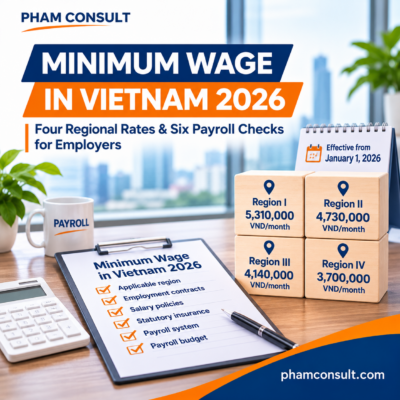
| Region I | 5,310,000 | 25,500 |
| Region II | 4,730,000 | 22,700 |
| Region III | 4,140,000 | 20,000 |
| Region IV | 3,700,000 | 17,800 |
Source: Clause 1, Article 3 of Decree No. 293/2025/ND-CP, effective January 1, 2026.
The monthly minimum wage applies to employees paid on a monthly basis who perform their agreed work or meet their labor norms under normal working conditions and fulfill the normal working hours for the month.
For employees paid by the hour, the wage for the relevant job or position must not be lower than the applicable regional minimum hourly wage.
These figures represent statutory minimum thresholds rather than uniform salary levels for every employee.
Employers remain free to offer higher wages based on job responsibilities, qualifications, experience and their compensation policies.
When applying the minimum wage in Vietnam 2026, businesses must also distinguish the minimum wage for the job or position from gross salary, net salary and other employment benefits.
2.1. How Much Did the Regional Minimum Wage Increase?
Compared with the rates under Decree No. 74/2024/ND-CP, the 2026 monthly minimum wages increased as follows:
| Region | Monthly Minimum Wage in 2025 | Monthly Minimum Wage in 2026 | Increase |
|---|---|---|---|
| Region I | 4,960,000 | 5,310,000 | 350,000 |
| Region II | 4,410,000 | 4,730,000 | 320,000 |
| Region III | 3,860,000 | 4,140,000 | 280,000 |
| Region IV | 3,450,000 | 3,700,000 | 250,000 |
These increases provide a useful starting point for businesses estimating the direct impact on their payroll budgets.
However, the actual financial impact depends on the number of affected employees, their contractual wages and other applicable employment arrangements.
3. How Should Employers Determine the Applicable Wage Region?
A common mistake when implementing the minimum wage in Vietnam 2026 is using the registered head office’s address to determine the wage rate for all employees.
Under Clause 3, Article 3 of Decree No. 293/2025/ND-CP, the applicable regional rate is determined according to the employer’s place of operation and the specific geographical rules.
Employers operating across several locations should therefore review the relevant administrative areas rather than assume one regional rate applies throughout the company.
3.1. Companies Operating Branches in Different Regions
Consider a foreign-invested enterprise with an administrative office located in Region I and a manufacturing facility located in Region II.
Where the two units operate in different wage regions, the applicable minimum wage generally follows the region in which each unit operates.
The business should not automatically apply the head office’s regional minimum wage to the factory simply because both units belong to the same legal entity.
Payroll records should therefore identify the relevant operating location and regional classification for each employee or business unit.
3.2. Does the Same Minimum Wage Apply Throughout Ho Chi Minh City?
Not necessarily.
The appendix to Decree No. 293/2025/ND-CP assigns specific administrative areas to different minimum wage regions.
Consequently, businesses should not assume that every ward, commune or other locality within Ho Chi Minh City belongs to Region I.
For example, the geographical appendix identifies areas within Ho Chi Minh City that fall under Region I, Region II and Region III.
Employers should verify the precise operating location against the official appendix before finalizing payroll calculations.
This requirement is particularly relevant to companies with production facilities or business locations outside central urban districts.
3.3. Industrial Parks Covering More Than One Wage Region
Under Point c, Clause 3, Article 3 of Decree No. 293/2025/ND-CP, an employer operating in an industrial park, export-processing zone, high-tech park or centralized digital technology zone that spans localities with different minimum wage levels must apply the rate of the locality with the highest minimum wage.
For example, where an industrial park extends across a Region I locality and a Region II locality, qualifying employers operating within that park must apply the Region I minimum wage.
This provision is particularly relevant to manufacturing businesses and foreign-invested enterprises operating in large industrial zones.
When determining the applicable rate, companies should verify their operational location and the boundaries of the industrial park rather than rely only on the general province or city name.
4. Does the Minimum Wage Increase Require Every Employee to Receive a Salary Raise?
No. An increase in the regional minimum wage does not automatically require employers to raise every employee’s salary by the same percentage.
If an employee’s wage for the agreed job or position already exceeds the applicable statutory minimum, an additional increase may not be legally required solely because the minimum wage has changed.
Nevertheless, the employer must review any relevant commitments under employment contracts, collective bargaining agreements and internal compensation policies.
Where the wage for a job or position falls below the new applicable minimum, the employer must take steps to bring it into compliance.
Under Clause 4, Article 5 of Decree No. 293/2025/ND-CP, employers must also review existing agreements and compensation arrangements and must not unilaterally remove or reduce lawful employee benefits merely because the minimum wage framework has changed.
Such benefits may include agreed overtime premiums, night-work payments and other favorable employment conditions.
4.1. What About Employees With Vocational Training or Hazardous Working Conditions?
Clause 4, Article 5 also addresses the continuation of lawful agreements or commitments that are more favorable to employees.
These may include previously agreed wage differences for jobs requiring vocational education or training, including arrangements providing wages at least 7% higher than the relevant minimum wage.
The provision also addresses existing commitments related to arduous, hazardous, dangerous or particularly arduous and hazardous working conditions.
However, employers should not interpret Decree No. 293/2025/ND-CP as automatically imposing an additional 7% wage premium for every trained employee in every circumstance.
The relevant obligations depend on the applicable agreements and legally established entitlements.
Businesses should review employment contracts, collective agreements, salary policies and existing commitments before making changes.
For the minimum wage in Vietnam 2026, the practical objective is to ensure that statutory adjustments do not result in the unlawful reduction of previously agreed employee benefits.
5. Practical Example: Adjusting an Employee’s Monthly Salary
Assume a foreign-invested company operates in a locality classified as Region I.
An employee working full-time under an employment contract receives a monthly wage for the job of VND 5,000,000.
From January 1, 2026, the minimum monthly wage for Region I is VND 5,310,000.
Assuming the employee is covered by the regulation and no other special circumstances apply, the agreed wage must be reviewed and adjusted so that it meets the new statutory minimum.
The difference is:
VND 5,310,000 − VND 5,000,000 = VND 310,000 per month.
However, the employer should not simply add VND 310,000 to the payroll budget and conclude that all related compliance requirements have been addressed.
The change may also require a review of employment documentation, relevant insurance contribution calculations, overtime-related pay and other contractual arrangements.
This hypothetical example illustrates a minimum wage comparison and does not represent an actual PHAM CONSULT client.
5.1. Converting Weekly, Daily and Piece-Rate Wages
Under Clause 3, Article 4 of Decree No. 293/2025/ND-CP, employers paying wages weekly, daily, by piece or on a lump-sum basis must ensure that the wages, when converted to the relevant monthly or hourly basis, are not below the applicable statutory minimum.
For employees paid weekly, the monthly equivalent is generally calculated by multiplying the weekly wage by 52 and dividing the result by 12.
For employees paid daily, the monthly equivalent is calculated by multiplying the daily wage by the number of normal working days in the month.
For piece-rate or lump-sum compensation, the employer must assess the remuneration corresponding to the work or output completed during normal working hours.
For example, an employee in Region II receives VND 220,000 per day and has 22 normal working days in a particular month.
The monthly equivalent is:
VND 220,000 × 22 = VND 4,840,000.
This exceeds the Region II monthly minimum wage of VND 4,730,000.
Nevertheless, employers must use the correct working-time arrangements, contractual requirements and applicable conversion principles when performing the actual calculation.
They should not automatically assume that every month has the same number of standard working days.
6. Six Payroll Checks Employers Should Complete in 2026
Updating the minimum wage in Vietnam 2026 requires coordinated action across human resources, payroll and finance departments.
The following six reviews provide a practical framework for businesses preparing or updating their payroll systems.
6.1. Verify the Applicable Wage Region
Identify the regional minimum wage for each operating location.
Companies with multiple factories, offices or branches should confirm the applicable region separately for each relevant unit.
The review should also consider industrial parks spanning more than one region and any transitional provisions affecting particular localities.
6.2. Review Employment Contracts
Compare each employee’s wage for the agreed job or position with the applicable minimum wage.
Where an adjustment is required, the employer should determine the appropriate contractual and administrative steps.
The review should also consider employees with different wage arrangements, including monthly, hourly and piece-rate remuneration.
6.3. Review Salary Policies and Collective Agreements
Employers should examine internal salary regulations, collective bargaining agreements and other relevant commitments.
Increases to statutory minimum wages should not be used as a basis for improperly reducing existing benefits.
In particular, previously agreed terms concerning trained workers, difficult working conditions, overtime or night work should be assessed.
6.4. Check Statutory Insurance Implications
Changes in regional minimum wages may affect certain thresholds or calculations used for statutory insurance obligations, depending on the insurance category and the employee’s circumstances.
Employers must distinguish between the regional minimum wage and the salary used as the basis for compulsory social insurance, health insurance and unemployment insurance.
These concepts are related but are not necessarily calculated using the same amount.
Payroll teams should therefore assess the relevant insurance legislation and employment documentation instead of assuming that every contribution automatically increases by the same percentage as the minimum wage.
6.5. Update Payroll Systems and Test Calculations
Payroll software should reflect the minimum wage applicable to each relevant employee, business unit or operating location.
Before implementing changes across the organization, employers should test payroll calculations using a representative sample of employees.
The test should include different regions, wage arrangements and any transitional employee categories.
This approach helps identify incorrect classifications or calculation settings before they affect an entire payroll period.
6.6. Review Employment Costs and Payroll Budgets
Finance teams should estimate the overall impact of wage adjustments on labor costs and operating budgets.
The assessment may include direct wage increases, relevant employer contributions and other contractual costs affected by the change.
For foreign-invested enterprises, the results may also need to be communicated to overseas parent companies for budgeting and management reporting.
7. Common Mistakes When Applying the Minimum Wage in Vietnam 2026
The first mistake is continuing to use 2025 minimum wage rates after Decree No. 293/2025/ND-CP became effective.
A second mistake is determining an employee’s wage region solely by the province or city name without checking the geographical appendix.
Employers may also fail to recognize special geographical rules for industrial parks spanning multiple wage regions.
Another common issue is applying a uniform salary increase to every employee without reviewing actual contractual wages and existing benefits. This may produce unnecessary expenditure or fail to address specific compliance requirements.
Businesses should also avoid treating the minimum wage, the insurance contribution salary and an employee’s take-home pay as interchangeable concepts.
Finally, employers must pay attention to transitional protection where a locality is classified into a lower wage region.
8. Frequently asked questions about the 2026 regional minimum wage
9. How can PHAM CONSULT support enterprises?
- Website: https://phamconsult.com/
- Email: info@phamconsult.com
- Phone: (028) 3930 2487
