


 VI
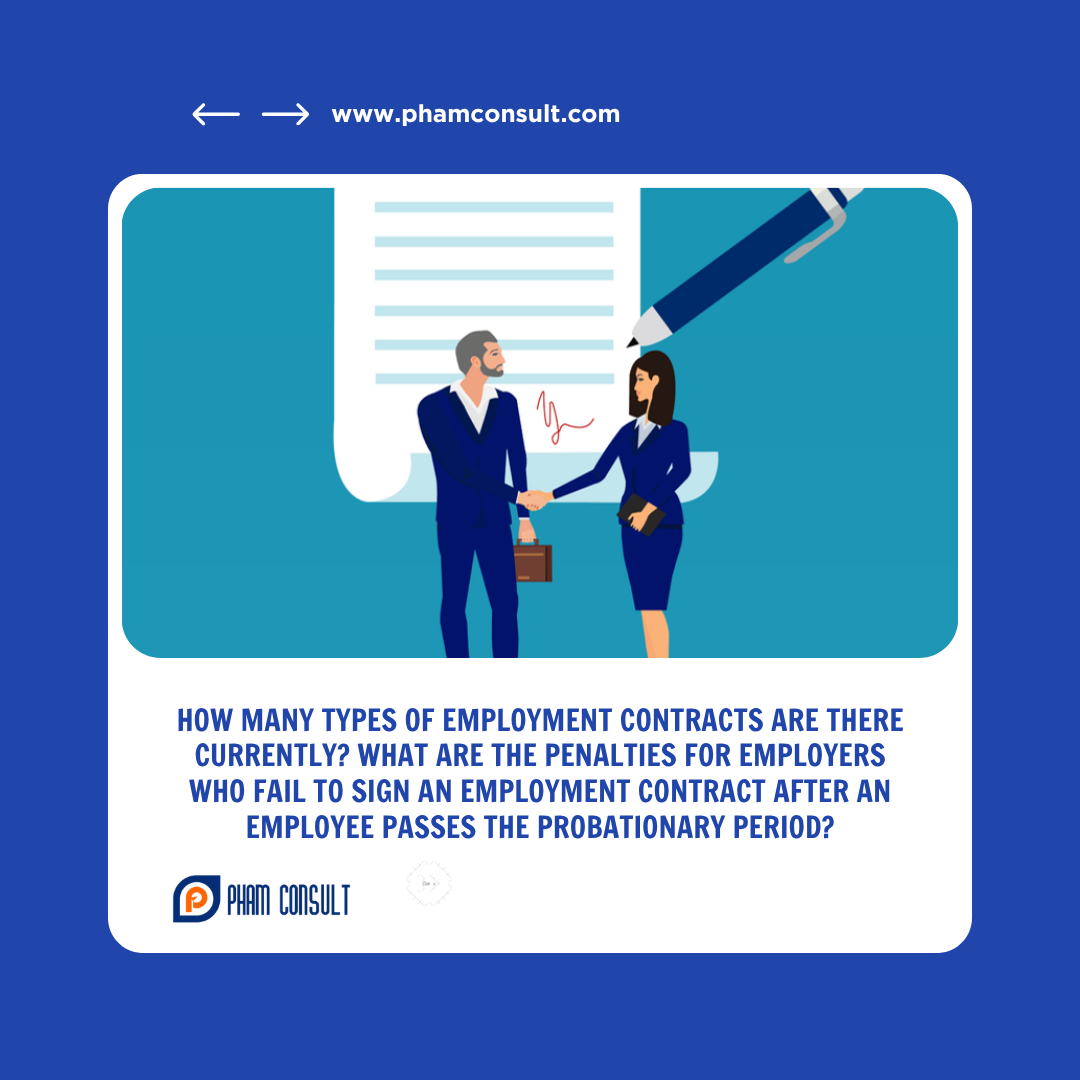
VI Entering into an employment contract is a fundamental legal basis for establishing the rights and obligations between an employer and an employee. However, in practice, many employers and employees are still not fully aware of the regulations governing the types of employment contracts and the employer’s obligation to conclude an employment contract once an employee successfully completes the probationary period. So, how many types of employment contracts are currently recognized under Vietnamese law? What penalties may an employer face for failing to sign an employment contract after an employee passes probation? Let’s explore these issues with Pham Consult in the article below.
1. How many types of employment contracts are currently recognized?
The 2019 Labor Code clearly stipulates the types of employment contracts that may be concluded, as well as the applicable duration of each type. Properly distinguishing between these contract types not only ensures compliance with the law but also protects the legitimate rights and interests of both employers and employees throughout the employment relationship.
Pursuant to Article 20 of the 2019 Labor Code, there are currently two (02) types of employment contracts:
- Indefinite-term employment contract: A contract in which the parties do not specify the duration or the termination date of the contract.
- Fixed-term employment contract: A contract in which the parties specify the duration and the termination date of the contract, provided that the term does not exceed 36 months from the effective date of the contract.
For fixed-term employment contracts, if the contract expires but the employee continues working:
- Within 30 days from the contract’s expiration date, the parties must enter into a new employment contract. During this period, the rights and obligations of both parties continue to be governed by the expired contract.
- If no new employment contract is signed within the 30-day period, the fixed-term employment contract shall automatically become an indefinite-term employment contract.
- If the parties enter into another fixed-term employment contract, they may do so only once. Thereafter, if the employee continues working, the employer must conclude an indefinite-term employment contract, except for certain cases specifically provided by the 2019 Labor Code.
2. What are the penalties for failing to sign an employment contract after an employee successfully completes probation?
Once an employee successfully completes the probationary period, the employer is required to conclude an employment contract if the parties previously entered into a probation agreement. Failure to do so may result in administrative penalties and remedial measures in accordance with the law.
Specifically, under Article 10 of Decree No. 12/2022/ND-CP, an employer who fails to conclude an employment contract with an employee who has successfully completed probation (where the parties have entered into a probation agreement) is subject to an administrative fine ranging from VND 2,000,000 to VND 5,000,000 if the violator is an individual.
Pursuant to Clause 1, Article 6 of Decree No. 12/2022/ND-CP, the above fines apply to individuals. Where the employer is an organization or enterprise, the fine shall be twice the amount imposed on an individual.
Accordingly, an enterprise that fails to sign an employment contract with an employee who has successfully completed probation may be fined from VND 4,000,000 to VND 10,000,000.
In addition to the administrative fine, Clause 3, Article 10 of Decree No. 12/2022/ND-CP also provides a remedial measure, requiring the employer to conclude an employment contract with the employee.
Note: Decree No. 12/2022/ND-CP remains effective until 9 September 2026. From 10 September 2026, it will be replaced by Decree No. 283/2026/ND-CP.
3. Who has the authority to enter into an employment contract in 2026?
In addition to determining the appropriate type of employment contract, it is equally important that the contract be signed by the person with proper legal authority. The 2019 Labor Code sets out specific provisions regarding the persons authorized to conclude employment contracts on behalf of both employers and employees, thereby ensuring the legal validity of the contract and minimizing potential disputes.
Pursuant to Article 18 of the 2019 Labor Code:
On the employee’s side:
- Employees shall directly enter into their employment contracts, except where otherwise provided by law.
- For seasonal work or specific jobs with a term of less than 12 months, a group of employees aged 18 or older may authorize one representative to conclude the employment contract on behalf of the group. Such authorization must be made in writing, and the contract must be accompanied by a list of the authorized employees.
On the employer’s side:
The person authorized to conclude an employment contract may be one of the following:
- The legal representative of the enterprise or a person duly authorized in accordance with the law.
- The head of an agency or organization with legal entity status, or a person duly authorized in accordance with the law.
- The representative of a household business, cooperative group, or another organization without legal entity status, or a person duly authorized in accordance with the law.
- An individual who directly employs workers.
For minor employees, the conclusion of an employment contract must comply with the specific provisions on contracting parties under Article 18 of the 2019 Labor Code.
Furthermore, the Labor Code expressly provides that a person authorized to conclude an employment contract may not further delegate such authority to another person.