


 VI
VI Participation in mandatory insurance schemes is both a fundamental right and a legal obligation of employees once an official employment relationship is established. The system of social insurance, health insurance, and unemployment insurance forms a solid social safety net, protecting employees against risks related to health, income, and employment. Full compliance with insurance contribution regulations not only ensures long-term benefits such as pensions and maternity allowances, but also serves as an important basis for authorities to monitor enterprises’ legal compliance. Understanding the categories of mandatory insurance helps employees safeguard their legitimate rights and proactively manage their personal social security benefits. Let Pham Consult clarify the types of insurance that employees are required to participate in when working.
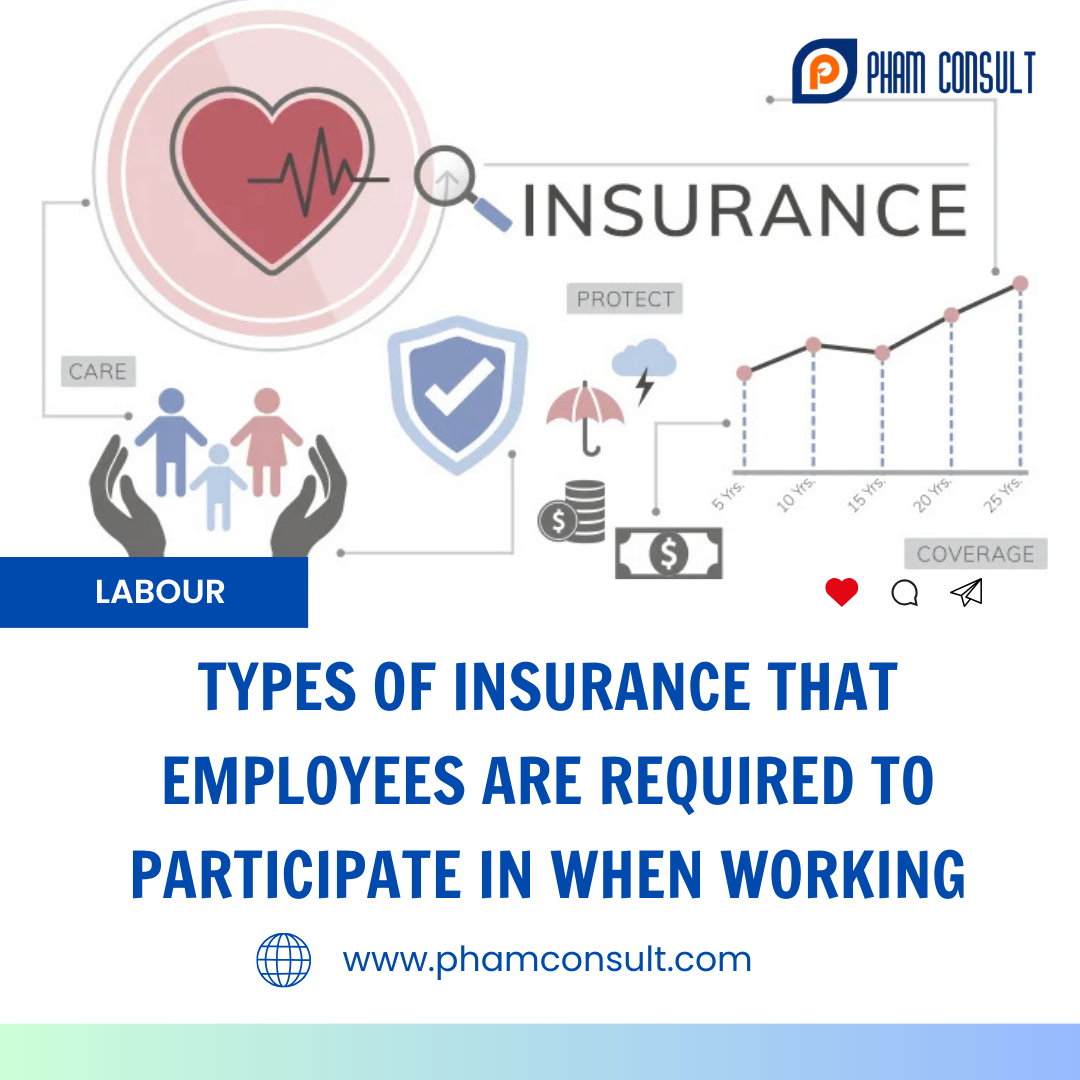
- Types of insurance employees must participate in when working
Mandatory insurance refers to insurance schemes prescribed by law, under which individuals or organizations are required to participate with a minimum contribution level as regulated. Both employees and employers are required to participate in mandatory insurance upon entering into an employment contract.
Pursuant to Clause 1, Article 168 of the 2019 Labor Code, employers and employees must participate in compulsory social insurance, health insurance, and unemployment insurance; employees are entitled to benefits in accordance with the laws on social insurance, health insurance, and unemployment insurance. Accordingly, there are three types of mandatory insurance that employees must contribute to on a monthly basis, including: compulsory social insurance, health insurance, and unemployment insurance.
- Social Insurance
Social insurance (SI) provides income replacement or partial compensation for participants when their income is reduced or lost due to illness, maternity, occupational accidents, occupational diseases, retirement, or death, based on contributions to the social insurance fund or support from the state budget.
According to Article 3 of the 2024 Law on Social Insurance, there are two types of SI: compulsory SI and voluntary SI.
– Compulsory SI is a state-organized insurance scheme in which employees and employers who fall under the compulsory category must participate. It includes the following benefits: sickness, maternity, retirement, survivorship, and occupational accident and disease insurance in accordance with the Law on Occupational Safety and Hygiene.
– Voluntary SI is a state-organized scheme in which Vietnamese citizens voluntarily participate and may choose contribution levels and methods suitable to their income. It includes benefits such as maternity allowance, retirement, survivorship, and occupational accident insurance.
Under the 2019 Labor Code, both employers and employees are required to participate in compulsory SI. Article 32 of the 2024 Law on Social Insurance stipulates the contribution rates for compulsory SI as follows:
– 3% of the salary used as the basis for SI contributions to the sickness and maternity fund;
– 22% of the salary used as the basis for SI contributions to the retirement and survivorship fund.
According to Clause 1, Article 33 and Clause 1, Article 34 of the 2024 Law on Social Insurance, the contribution rates are:
– Employee: 8% of the monthly salary to the retirement and survivorship fund;
– Employer: 17% of the monthly salary, including:
+ 3% to the sickness and maternity fund;
+ 14% to the retirement and survivorship fund.
- Health Insurance
Health insurance (HI) is a mandatory insurance scheme applied to subjects specified under the Law on Health Insurance for healthcare purposes, organized by the State on a non-profit basis. Its objective is to reduce the financial burden on participants when accessing medical examination and treatment, and to facilitate better access to quality healthcare services based on the principle of risk-sharing among participants.
According to Clause 1, Article 3 of the 2008 Law on Health Insurance (as amended in 2024), the contribution rate is determined as a percentage of the salary used as the basis for compulsory social insurance contributions (hereinafter referred to as the monthly salary), pension, allowance, or reference level.
Pursuant to Point a, Clause 1, Article 6 of Decree No. 188/2025/ND-CP, the monthly contribution rate for applicable subjects is 4.5% of the monthly salary used as the basis for compulsory SI contributions, of which: the employer contributes two-thirds (3%) and the employee contributes one-third (1.5%).
- Unemployment Insurance
Unemployment insurance (UI) is a mandatory insurance scheme organized by the State, in which employees and employers participate to support job retention, training, career counseling, job placement, and to partially compensate employees’ income in case of job loss, based on contributions to the unemployment insurance fund.
According to Clause 1, Article 33 of the 2025 Law on Employment, the contribution rates and responsibilities are:
– Employee: up to 1% of the monthly salary;
– Employer: up to 1% of the total monthly payroll of employees participating in unemployment insurance.
In summary, each month, employees will have 10.5% of their salary deducted for mandatory insurance contributions (including: 8% for social insurance, 1.5% for health insurance, and 1% for unemployment insurance). This is both an obligation and a benefit, ensuring employees’ social security, healthcare, and employment stability throughout their working life.