


 VI
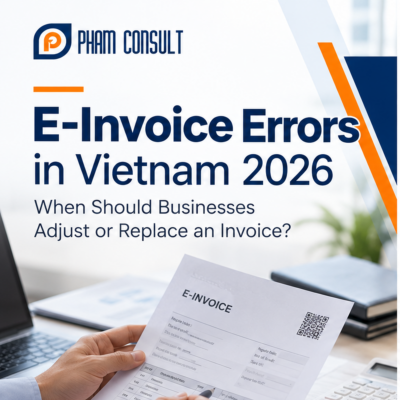
E-Invoice Errors in Vietnam 2026: When Should Businesses Adjust or Replace an Invoice?
Updated: October 28, 2026
Electronic invoices are an essential part of accounting and tax compliance for businesses operating in Vietnam. However, errors can occur even when companies have established invoicing procedures and accounting software in place.
An invoice may contain an incorrect buyer name, tax identification number, payment amount, VAT rate or description of goods and services. Although these mistakes may appear similar, they do not necessarily require the same corrective action.
For foreign-invested enterprises (FIEs), handling e-invoice errors can be particularly challenging when invoicing information must also be reconciled with accounting records, customer transactions and financial reporting systems used by overseas parent companies.
Since July 1, 2026, Vietnam has applied a new regulatory framework for electronic invoices under Decree No. 254/2026/ND-CP and Circular No. 91/2026/TT-BTC.
Under these regulations, certain invoice errors can be addressed through notification without issuing a new invoice. Other mistakes may require an adjustment invoice or a replacement invoice, while some categories of electronic invoices are subject to specific procedures.
This guide explains how businesses should identify and handle e-invoice errors in Vietnam in 2026, including the relevant legal requirements, documentation procedures, practical examples and a five-step internal review process.
1. Legal Framework for E-Invoice Errors in Vietnam in 2026
Before correcting an issued electronic invoice, businesses should identify the regulations applicable to the invoice and the transaction involved.
On June 30, 2026, the Government of Vietnam issued Decree No. 254/2026/ND-CP, detailing certain provisions of and implementation measures for Law on Tax Administration No. 108/2025/QH15 concerning electronic invoices and electronic documents.
Its official Vietnamese title is Nghị định số 254/2026/NĐ-CP quy định chi tiết một số điều và biện pháp để tổ chức, hướng dẫn thi hành Luật Quản lý thuế số 108/2025/QH15 về hóa đơn điện tử, chứng từ điện tử.
On the same day, the Ministry of Finance issued Circular No. 91/2026/TT-BTC, providing regulations for the implementation of the Law on Tax Administration and Decree No. 254/2026/ND-CP concerning electronic invoices and electronic documents.
Its official Vietnamese title is Thông tư số 91/2026/TT-BTC quy định một số điều của Luật Quản lý thuế và Nghị định số 254/2026/NĐ-CP của Chính phủ quy định chi tiết một số điều và biện pháp để tổ chức, hướng dẫn thi hành Luật Quản lý thuế số 108/2025/QH15 về hóa đơn điện tử, chứng từ điện tử.
Both instruments took effect on July 1, 2026.
Businesses can consult the official texts through the Government of Vietnam’s publication of Decree No. 254/2026/ND-CP and the Official Gazette’s publication of Circular No. 91/2026/TT-BTC.
1.1. What changed in the treatment of incorrectly issued invoices?
Article 10 of Circular No. 91/2026/TT-BTC establishes the procedures for handling issued electronic invoices.
The applicable approach depends primarily on the nature of the error and the type of invoice concerned.
For example, an incorrect buyer address may be handled differently from an incorrect tax identification number or VAT amount. Similarly, an electronic invoice generated from a cash register may require a different corrective procedure from a standard electronic invoice.
Consequently, businesses should not automatically issue a replacement invoice whenever an error is discovered.
1.2. Do the 2026 rules apply to older invoices?
The effective date of the new legislation is important, particularly for businesses reviewing transactions from earlier accounting periods.
Before July 1, 2026, electronic invoicing was governed by a regulatory framework that included Decree No. 123/2020/ND-CP, Decree No. 70/2025/ND-CP and Circular No. 32/2025/TT-BTC.
Circular No. 91/2026/TT-BTC introduces the updated procedures and also contains transitional provisions under Article 24.
For invoices issued under earlier regulations, businesses should review the relevant transitional provisions before deciding how to make a correction.
An invoice’s original issue date, the applicable invoicing regime and the circumstances in which the error was discovered may affect the appropriate procedure.
2. How Should Businesses Handle Different Types of E-Invoice Errors?
The first step in resolving e-invoice errors is determining whether the incorrect information concerns a non-material detail or a substantive element of the transaction.
Clause 1, Article 10 of Circular No. 91/2026/TT-BTC establishes several distinct situations.
2.1. Incorrect Buyer Name or Address Without Errors in Material Information
Under Point a, Clause 1, Article 10 of Circular No. 91/2026/TT-BTC, where an issued electronic invoice contains errors in information such as the buyer’s name, address or amount in words, but the tax identification number, invoice amount, tax rate, tax amount and goods information remain correct, the seller does not have to reissue the invoice.
Instead, the seller must notify the buyer of the incorrect information and submit a notification to the tax authority using Form No. 04/SS-HĐĐT, provided in Appendix III of the Circular.
For example, consider a company that issues an invoice containing an incomplete street address for its customer. The customer’s tax identification number, invoiced amount, VAT rate and goods information are otherwise accurate.
If the invoice satisfies the conditions under Point a, Clause 1, Article 10, the seller may follow the notification procedure without issuing a replacement invoice.
However, businesses should first confirm whether the invoice belongs to a category subject to special rules, particularly electronic invoices generated from cash registers.
This distinction is important because an administrative error does not always require a new invoice, but the applicable invoice category still needs to be verified.
2.2. Incorrect Tax Identification Number, Amount, VAT Rate or Goods Information
More substantive e-invoice errors are addressed under Point b, Clause 1, Article 10 of Circular No. 91/2026/TT-BTC.
This provision covers errors involving the tax identification number, goods description, specifications or quality, invoice amount, tax rate, tax amount and other mandatory information outside the scope of Point a.
In these circumstances, the seller may generally choose between issuing an adjustment invoice and a replacement invoice, subject to the applicable conditions and special rules.
An adjustment invoice records the correction made to the previously issued invoice. It must clearly identify the original invoice being adjusted, using the required reference information.
A replacement invoice is a new electronic invoice issued to replace the incorrect invoice. It must similarly identify the original invoice that it replaces.
The Circular prescribes the reference wording required for these documents. Businesses should follow the prescribed Vietnamese wording and invoice reference format in their invoicing system rather than relying on an informal English description.
After preparing the relevant electronic invoice, the seller digitally signs and transmits it according to the applicable procedure.
For electronic invoices without a tax authority code, the seller sends the invoice to the buyer. For invoices requiring a tax authority code, the seller submits the new invoice for coding before sending it to the buyer.
The appropriate option should be selected after examining the nature of the underlying error, the transaction documents and the consequences for accounting and tax reporting.
2.3. Incorrect Electronic Invoices Generated From Cash Registers
An important exception concerns electronic invoices generated from cash registers and invoices for certain assets subject to mandatory ownership or use-right registration.
Under Point c, Clause 1, Article 10 of Circular No. 91/2026/TT-BTC, where these invoices contain errors, the seller must issue a replacement invoice, except for the specific situation described in Point c.2, Clause 5 of the same Article.
This distinction is relevant to businesses that use cash-register electronic invoicing in retail and consumer-facing operations.
The accounting team should therefore verify the invoice type before selecting a correction method.
A company should not assume that the same adjustment procedure available for a standard business invoice can automatically be applied to a cash-register invoice.
2.4. Multiple Incorrect Invoices Issued to the Same Buyer
E-invoice errors can sometimes result from an incorrect customer record, a software configuration issue or repeated data-entry mistakes.
Where multiple invoices issued to the same buyer within the same month contain the same types of incorrect information specified by the regulation, the seller may be permitted to issue one adjustment invoice or replacement invoice covering multiple incorrect invoices.
Under Point b, Clause 1, Article 10 of Circular No. 91/2026/TT-BTC, the relevant correction must be accompanied by a list of the affected invoices using Form No. 01/BK-ĐCTT in Appendix III.
The provision covers the specified circumstances involving the same buyer and errors relating to buyer information, goods descriptions, unit prices, quantities or tax rates within the same month.
Businesses should not combine unrelated corrections or invoices from different periods without confirming that the statutory conditions have been satisfied.
The accounting team should also maintain a clear record identifying which original invoices are covered by the adjustment or replacement.
3. E-Invoice Errors in Vietnam: Quick Reference Table
The following table summarizes the main situations businesses may encounter when reviewing incorrectly issued electronic invoices.
| Type of error or situation | General treatment | Legal reference |
|---|---|---|
| Incorrect buyer name, address or amount in words, with material information correct | Notify the buyer and tax authority; no new invoice required | Point a, Clause 1, Article 10 |
| Incorrect tax identification number, goods information, amount, VAT rate or tax amount | Adjustment or replacement, subject to applicable conditions | Point b, Clause 1, Article 10 |
| Incorrect cash-register e-invoice | Replacement invoice, subject to specified exception | Point c, Clause 1, Article 10 |
| Multiple eligible invoices containing the same types of errors for one buyer in one month | A consolidated adjustment or replacement may be allowed with Form 01/BK-ĐCTT | Point b, Clause 1, Article 10 |
| Further errors discovered after an invoice has already been adjusted or replaced | Continue using the correction method selected initially | Point a, Clause 6, Article 10 |
| Goods returned after an invoice has been issued | Follow the separate adjustment or return-invoice procedure, as applicable | Point c, Clause 5, Article 10 |
This table provides a general overview. Each case must be assessed against the complete provisions and exceptions of Circular No. 91/2026/TT-BTC.
The table is intended to support an initial review, not to replace a legal assessment of the specific transaction.
4. What Documents Are Required Before Correcting an E-Invoice?
Correcting an electronic invoice is not necessarily limited to selecting an option in an invoicing platform.
Certain cases require communication between the seller and buyer and the retention of supporting documents.
4.1. Written Agreement Between Seller and Buyer
Point b, Clause 1, Article 10 of Circular No. 91/2026/TT-BTC establishes requirements that apply before an incorrectly issued invoice is adjusted or replaced under that provision.
Where the buyer is an economic organization, another organization, a business household or an individual conducting business, the seller and buyer must prepare a written agreement identifying the incorrect information.
Where the buyer is an individual consumer, the seller must notify that person or publish the notification on the seller’s website, if applicable.
The seller is responsible for retaining the written agreement and presenting it when requested by the tax authority or another competent state authority.
The Circular also identifies situations in which the written agreement is not mandatory, including certain electronic invoice data-transmission arrangements and qualifying transactions conducted through e-commerce or other digital platforms.
Accordingly, the documentation requirement should be determined by the buyer’s status, the invoicing arrangement and any applicable exception.
Businesses dealing with an incorrect buyer tax identification number can refer to PHAM CONSULT’s related article: What Must the Seller and Buyer Do Before Correcting or Replacing an E-Invoice With an Incorrect Tax Identification Number?
4.2. Supporting Commercial and Accounting Documents
Before deciding how to correct an invoice, businesses should verify the underlying transaction.
Relevant documents may include the sales contract, purchase order, delivery confirmation, payment record, customer information and supporting accounting entries.
For example, an incorrect VAT amount may result from applying the wrong VAT rate, calculating a transaction incorrectly or entering an incorrect value into the invoicing system.
The nature of the error should be established before the company issues the corrective invoice.
Without appropriate document verification, a corrected invoice may still be inconsistent with the company’s accounting records or the customer’s supporting information.
For foreign-invested enterprises, this process may also require coordination between the Vietnamese accounting team and the finance department of an overseas parent company.
5. A Five-Step Process for Handling E-Invoice Errors
Businesses can use the following five-step process as an internal management framework when an incorrectly issued electronic invoice is discovered.
Step 1. Identify the Invoice Type and Incorrect Information
The accounting team should determine whether the invoice has a tax authority code, whether it is an invoice generated from a cash register and whether any special invoicing rules apply.
Next, the team should identify exactly which fields are incorrect.
A mistake in the buyer’s address may require different treatment from an incorrect tax identification number, invoice amount or VAT rate.
Correct classification at this stage helps prevent the company from selecting an inappropriate correction method.
Step 2. Verify the Underlying Transaction
The relevant accounting and commercial records should be reviewed to establish the correct information.
This may involve checking contracts, payment records, goods delivery documents, customer registration details and previously recorded accounting entries.
Where the error concerns VAT, the company should determine the correct tax treatment of the underlying goods or services rather than automatically applying a standard rate.
Step 3. Select the Appropriate Legal Procedure
After identifying the nature of the error, the business should determine whether the law requires a notification, permits an adjustment or replacement, or prescribes a special procedure.
For a standard incorrectly issued invoice covered by Point b, Clause 1, Article 10, the seller should also determine whether a written agreement with the buyer is required.
The company should document the rationale for the chosen method and ensure that the staff responsible for issuing the corrective document understand the relevant legal requirements.
Step 4. Issue the Corrective Document and Complete Required Notifications
Where an adjustment or replacement invoice is required, the accounting team should ensure that the document correctly identifies the original invoice.
The new electronic invoice must be digitally signed and transmitted using the applicable procedure.
Where the error is addressed through a notification, the seller should complete the required notification process, including Form No. 04/SS-HĐĐT when applicable.
All relevant records should be retained to support future reconciliation or review.
Step 5. Review the Accounting and Tax Implications
Once the invoice has been corrected, the accounting team should assess whether the error affects revenue, expenses, receivables, payables or VAT reporting.
It is important to distinguish between correcting an invoice and amending a tax return.
Issuing an adjustment or replacement invoice does not automatically mean that every related tax amount must be reported in the same period.
The appropriate tax treatment depends on the type of transaction, the original error, the applicable declaration rules and any relevant provisions governing adjustments.
For example, Point d, Clause 6, Article 10 of Circular No. 91/2026/TT-BTC specifies a declaration-period treatment for adjustment invoices arising under Clause 5 of that Article. This should not be generalized to every invoice correction under Clause 1.
If previously submitted tax returns may be affected, businesses should assess the applicable tax administration rules before deciding whether a supplementary filing is necessary.
6. Practical Example: An Invoice Issued With the Wrong VAT Rate
Consider a hypothetical foreign-invested service company operating in Vietnam.
The company issues an electronic invoice to a corporate customer. After the invoice has been sent, the accounting team discovers that the VAT rate shown on the invoice may be incorrect.
The company should first establish the appropriate VAT treatment for the service, taking into account the relevant tax provisions and the actual nature of the transaction.
It should then examine the original invoice, contract, supporting documents and accounting entries to determine the correct amounts.
If the case falls within Point b, Clause 1, Article 10 of Circular No. 91/2026/TT-BTC, the seller may generally select an adjustment or replacement invoice, subject to the applicable requirements.
Because the buyer is a business, the parties should also consider the written agreement requirement before issuing the corrective invoice.
After completing the correction, the accounting team should review whether the incorrect VAT rate affected any accounting records or previously filed tax information.
The result should be documented and checked before the relevant reporting information is finalized.
This example illustrates why the proper handling of e-invoice errors requires both an understanding of the invoicing regulations and an accurate assessment of the transaction itself.
This example is hypothetical and does not describe an actual PHAM CONSULT client engagement.
7. Common Mistakes Businesses Should Avoid
7.1. Assuming Every Invoice Error Requires a Replacement
Not all e-invoice errors require a new invoice.
Under Point a, Clause 1, Article 10, certain errors can be addressed through buyer notification and the prescribed tax authority notification procedure.
Conversely, some special invoice categories require replacement rather than an ordinary adjustment.
Businesses should identify the type of error before deciding what document to issue.
7.2. Failing to Retain Required Agreements
Where a written agreement is required, an informal telephone conversation or an internal software note may not satisfy the documentation requirements.
The company should retain the agreement and relevant supporting records in a manner that allows them to be retrieved when necessary.
7.3. Changing the Correction Method After Further Errors Are Discovered
Point a, Clause 6, Article 10 of Circular No. 91/2026/TT-BTC addresses invoices that have already been adjusted or replaced but are subsequently found to contain further errors.
In this situation, subsequent corrections must follow the same method used for the initial correction.
For example, a company that originally selected the adjustment method should not automatically switch to a replacement method when another error is identified.
This makes the initial assessment and documentation particularly important.
7.4. Correcting the Invoice but Ignoring Accounting Differences
An invoice can be corrected in accordance with the relevant invoicing procedure while discrepancies remain in the company’s accounting system.
The accounting team should therefore reconcile the corrected document with the underlying transaction, payment records and related financial information.
This helps reduce the risk of differences between invoices, tax records and management reporting.
7.5. Treating Goods Returns as Ordinary Invoice Errors
An invoice may have been correct when issued, but the customer subsequently returns all or part of the goods.
This is not necessarily the same situation as discovering an incorrect invoice.
Point c, Clause 5, Article 10 of Circular No. 91/2026/TT-BTC establishes separate procedures for returns, including circumstances where the seller issues an adjustment invoice or the buyer issues a return invoice under an agreement.
Special rules also apply to certain assets requiring ownership or use-right registration.
Businesses should therefore distinguish between an original invoicing error and a later commercial event that changes the transaction.
8. Frequently Asked Questions About E-Invoice Errors in Vietnam
8.1. Must a company replace an e-invoice if the buyer’s address is incorrect?
Not necessarily.
Where the incorrect address falls within Point a, Clause 1, Article 10 of Circular No. 91/2026/TT-BTC and the tax identification number, invoice amount, tax rate, tax amount and goods information remain correct, the seller generally follows the notification procedure without issuing a new invoice.
Special invoice categories must be assessed separately.
8.2. Can an invoice with an incorrect tax identification number be adjusted?
Yes, where the case falls within Point b, Clause 1, Article 10 and no special provision requires another method.
The seller may generally choose adjustment or replacement and must comply with the applicable documentation and transmission requirements.
8.3. Can several incorrect invoices be corrected together?
Yes, in the circumstances specified in Point b, Clause 1, Article 10.
Where the conditions concerning the same buyer, the same month and the relevant types of errors are met, the seller may issue a consolidated adjustment or replacement with the required invoice list using Form No. 01/BK-ĐCTT.
8.4. What happens if an adjustment invoice contains another error?
Under Point a, Clause 6, Article 10, subsequent corrections must generally follow the same method used for the initial correction.
The business should review the full sequence of invoices and corrective documents before proceeding.
8.5. Does correcting an e-invoice automatically require an amended VAT return?
Not in every case.
The company needs to determine whether the error affects tax information already declared and which declaration provisions apply.
The applicable treatment may differ depending on whether the issue concerns an original invoicing error or a subsequent adjustment arising from another transaction event.
8.6. Do foreign-invested companies follow different e-invoice correction rules?
Foreign-invested enterprises operating in Vietnam must comply with the Vietnamese electronic invoicing rules applicable to their transactions and invoice types.
Although additional group reporting requirements may create operational complexity, they do not automatically replace the local invoicing procedures.
Businesses should ensure that corrective invoices, accounting entries and financial reporting adjustments are appropriately reconciled.
9. How Can PHAM CONSULT Support Your Business?
For companies operating in Vietnam, handling e-invoice errors is not merely an administrative task.
Incorrect invoicing information can create inconsistencies between accounting records, tax declarations, customer balances and financial reports. These issues may become more difficult to manage when a company processes large transaction volumes or reports financial information to an overseas parent company.
PHAM & ASSOCIATES CONSULTING COMPANY LIMITED (PHAM CONSULT) provides professional tax consulting and accounting services for businesses operating in Vietnam, including foreign-invested enterprises.
Depending on the agreed scope of engagement, PHAM CONSULT can support businesses in reviewing accounting documentation, assessing tax-related issues, improving accounting procedures and addressing compliance questions concerning invoices and supporting records.
Companies seeking professional assistance can learn more about PHAM CONSULT’s Tax Consulting Services and Accounting Services.
If your business has identified e-invoice errors or needs assistance reviewing the related accounting and tax implications, please contact PHAM CONSULT to discuss your specific circumstances.
PHAM & ASSOCIATES CONSULTING COMPANY LIMITED (PHAM CONSULT)
Website: https://phamconsult.com/
Email: info@phamconsult.com
Ho Chi Minh City Office: +84 28 3930 2487
Disclaimer: This article provides general information about electronic invoicing requirements in Vietnam as of October 28, 2026. The appropriate treatment of an invoice depends on the transaction, invoice category, relevant dates, supporting documents and applicable legislation. This material does not replace professional advice concerning a specific business situation.
